
Ready to Take Your Own Sun Sabbatical? Moving to the PNW FAQ
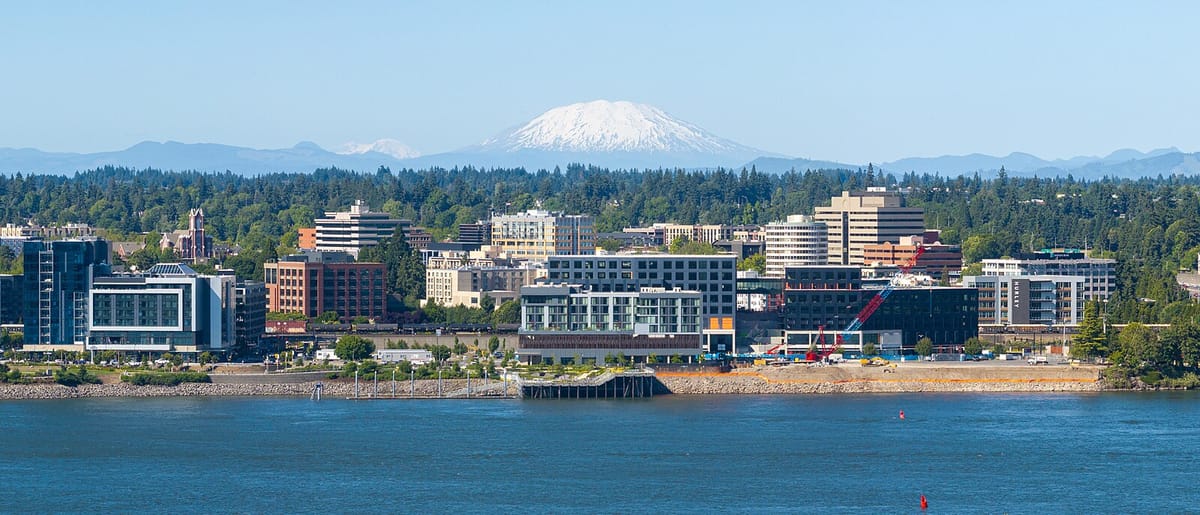
Below are some frequently asked questions about what it's like to live in Vancouver, Washington to determine if this is the right move for you. We'll cover topics like regional history and background, financial stuff, weather, lifestyle and culture, and families with kids. Without further ado:
History/Background
- "What is the Indigenous/Native history of Vancouver, WA?"
- Southwest Washington is located on the traditional lands of the Cowlitz Indian Tribe, Confederated Tribes of the Chehalis Reservation, members of the Chinook Indian Nation, and Klickitat members of the Confederated Tribes and Bands of the Yakama Nation. These communities have stewarded the area surrounding the Columbia River for thousands of years. The arrival of the Hudson's Bay Company's Fort Vancouver Post in 1825 and the United States Army in 1949 brought white settlement efforts which included often violent conflict with and displacement of Indigenous communities. Some tribes have been able to acquire federal recognition which has enabled them to enter into Indian gaming and casinos. While this shouldn't have to happen, it is the main way that tribes are able to achieve their #landback goals. For instance, the Cowlitz Tribe has been able to acquire nearly 200-acres of land since federal recognition in 2015. They have used this opportunity to bring about habitat restoration of fish populations along the Washougal River, too.
- "Was British Columbia or Washington the first Vancouver?"
- Vancouver, Washington was named after the British Royal Navy Captain George Vancouver, who was tasked with exploring the Pacific Northwest and the Columbia River in 1792. Fort Vancouver was the center of the Hudson's Bay Company's fur trading empire in the Pacific Northwest. The city of Vancouver, WA, was later incorporated in 1857, nearly thirty years before its Canadian counterpart, Vancouver, British Columbia, was incorporated in 1886. (TL;DR: Vancouver WA was the first Vancouver!)
Financial Stuff
- "What is the Cost of Living in Vancouver WA?"
- The cost of living in Vancouver, WA is somewhat higher than the national average primarily due to housing and its proximity to Portland, OR. Vancouver is a lot less expensive than Seattle, but more expensive than most other Washington cities.
- "No state income tax Vancouver WA"
- Washington State does not have income tax. However, to compensate for this revenue loss, the state imposes some of the steepest sales taxes, most notably in consumption and business, in addition to other taxes. For Vancouver, WA residents, the easy fix is to head 15-minutes over the interstate bridge into Portland to take advantage of Oregon's lack of sales tax.
- "If I work in Portland, but live in Vancouver, do I have to pay income tax?"
- Yes, if you live in Vancouver, WA but physically work in Portland, OR, you must pay Oregon income tax on the income you earn in Oregon. Washington has no state income tax, but Oregon does, and you are subject to the income tax laws of the state where the income is sourced (where you physically perform the work). The opposite is true, too.
- "Is Vancouver WA cheaper than Portland?"
- Yes, Vancouver, WA is slightly cheaper than Portland, but it largely has to do with the income taxes people pay when they live in Oregon. Save for the income tax situation, Vancouver and Portland are similar in cost, especially in recent years. Vancouver, WA has been developing a ton of housing to accomodate all the people moving here, and that has caused housing prices to increase to comparable levels with Portland, granted it depends where in Portland we compare. At the same time, there is a noticeable trend of people leaving Portland, so that has caused the Portland housing market to correct itself (become less expensive with less demand).
Weather
- "Does it rain all the time in Vancouver WA?"
- No! I mean, yes, but also no. It rains about eight (8) months out of the year from October through May, and it's sunny from about June through September. Vancouver WA is known for a mild and wet rainy season, which means we tend to have a frequent drizzle or light mist from October through May. We do have atmospheric rivers sometimes which can bring heavy rain, but we are also really good at managing water runoff into rivers and creeks. The rain, for the most part, while consistent, doesn't disrupt daily life. People still bicycle, run, play, etc. in the rain.
- "Is the Vancouver WA winter cold and gray?"
- Yes, for the most part. Every couple weeks in early December, we get entire days of sunshine, but when winter proper begins in mid to late December, it can be cold, wet, and gray for many weeks at a time. During early January, the sun rises at 7:50a and sets at 4:30p, so that can make for pretty short days. But! By the end of January, the days start to get a little longer, as we begin our transition to spring.
- "How much snow does Vancouver WA get?"
- We get about 2 inches of snow a year in Vancouver, and it usually happens the week of Valentine's Day (February 14). Depending on the year, we might get ice storms or delicate snow. There is a reason that a lot of people drive Subarus up here as they are all All-Wheel Drive (AWD) which is really handy for navigating icy roads and snow.
- "Does Seasonal Affective Disorder (SAD) really exist?"
- Yes. Also known as Seasonal Depression, Seasonal Affective Disorder exists because sunlight helps our bodies to produce Vitamin D which helps to jumpstart Seratonin (the happy hormone). Without sunlight, Vitamin D and Seratonin can be hard to come by, and our bodies get a little sad.
- "Tips for Dealing with Seasonal Affective Disorder (SAD)?"
- Happy Lights mimic sunlight and help to artificially produce Vitamin D and jumpstart Seratonin. Be sure to not look directly at them! Other ways to deal with seasonal depression is to open all of your blinds, sit by the window, get in the sunlight any chance you get, find a mental health counselor or therapist, take advantage of the moments when it's not raining to get some outdoor exercise, go on a walk, take a Vitamin D supplement, eat well, and drink tea. Embrace the coziness of the season, make a fire in the fireplace, and curl up with a good book.
- "What is fall like in Vancouver WA?"
- Beautiful! Because we have a mild version of all four seasons, our autumn is just really breathtaking.
- "What is winter like in Vancouver WA?"
- "What is spring like in Vancouver WA?"
- "What is summer like in Vancouver WA?"
Lifestyle
- "Is Vancouver WA a good place to live?"
- "Pros and cons of living in Vancouver WA"
- "Is Vancouver WA safe?"
- "Is Vancouver WA diverse?"
- "Is there ethnic food in Vancouver WA?"
- "What is there to do in Vancouver WA?"
- "Is Vancouver WA progressive/liberal/blue/conservative/red?"
- "What are the biggest challenges moving to Vancouver, WA?"
- Western Washington has a reputation for being reserved / polite, but unfriendly. Some people call it the "Seattle Freeze," and while not everyone is like this, it is pretty common along Western Washington as a whole. (Spoiler: it has to do with the rainy weather!)
- Introversion
- Because of the constant drizzle 80% of the year, people in Western Washington don't tend to stop and chat with each other any other part of the year. To the untrained eye, people in Western Washington can come off as unfriendly, but that isn't the case—they're just used to having to get out of the rain! Keep in mind: introversion is not rudeness.
- Reserved
- Because of the above, people have gotten into the habit of not acknowledging others, but if given a good reason to chat, it'll happen. People from Western Washington sometimes tend to keep to themselves and are not known for spontaneously chatting with strangers. Because people in Washington are pretty understated and casual, folks are not going out of their way to feign friendliness or interest.
- Casual / Understated
- Many people in Washington opt for functionality over fashion: rainjackets instead of umbrellas, waterproof shoes over rainboots. This is all part of a broader understated, casual culture. This has to do with the blend of the West Coast casual culture, outdoorsy access to nature, historical roots in blue-collar work like logging and timber, and rainy weather.
- "Do people in Washington really not like Californians?"
- It's not that people dislike Californians, it's that many investors are from California and price people out of their homes and communities. Many people feel protective over what used to be a more rural Southwest Washington, so the impression they get from Californians is that many of us are moneygrabbers and snooty. If you're the salt of the Earth and ready to come contribute, then I'm sure you'll find a warm welcome.
Gardening
- "What USDA Plant Hardiness Zone is Vancouver WA?"
- We live in Zone 8b which means we
- "What fruits and vegetables grow in Vancouver WA?"
- "Recommendations for native plants and habitat restoration in Vancouver WA?"
Kids
- "How are the schools in Vancouver WA?"
- "What's the best neighborhood for families in Vancouver?"
- "What is there to do for kids in Vancouver WA?"